
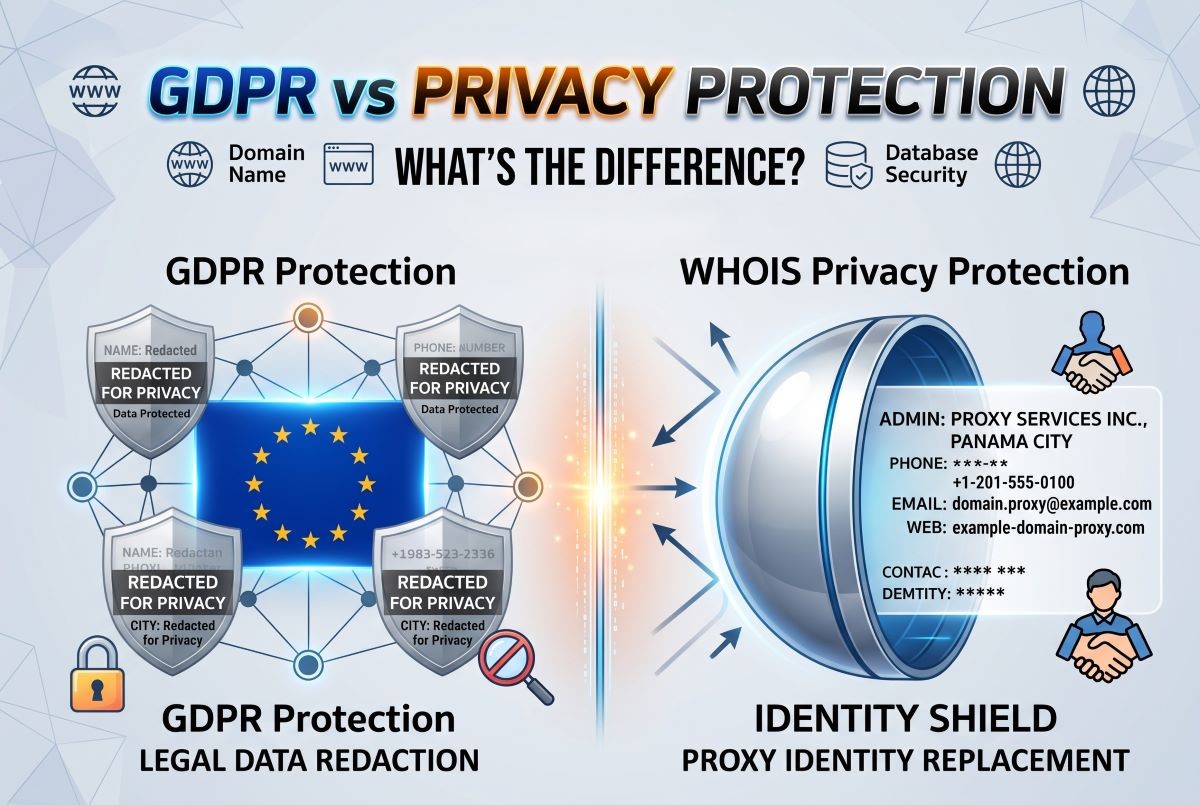
When registering and managing a domain name, protecting registrant contact details in the public WHOIS database is essential to defend against unsolicited spam, identity theft, and malicious harvesting. In modern domain control panels, you will frequently encounter two closely related settings: GDPR Protection and Privacy Protection. While both aim to preserve privacy, they operate under fundamentally different frameworks, technical mechanisms, and operational workflows.
- GDPR Protection (Regulatory Data Masking)
This feature was established following the enforcement of the European Union's General Data Protection Regulation (EU GDPR). To maintain legal compliance, ICANN adopted the Temporary Specification for gTLD Registration Data, requiring registrars globally to restrict the public display of personal identifying information.
- Mechanism: The registrar redacts or masks sensitive contact fields directly at the registry level. Fields such as registrant name, street address, and phone number are replaced with standard system notices like "REDACTED FOR PRIVACY" or "Data Protected".
- Communication: Third parties wishing to communicate with the registrant must submit queries through an anonymized webform hosted by the registrar or registry. The owner's personal email is never published.
- Cost: Included at no additional cost, as it is a baseline compliance feature mandated by global privacy laws
.
- Privacy Protection / WHOIS Privacy (Proxy Relay Service)
A specialized identity proxy service that predates GDPR, designed specifically for registrants who require active proxy shielding and streamlined email forwarding.
- Mechanism: Instead of simply blanking out data, the system substitutes the registrant's details with the legitimate contact information of a dedicated privacy holding entity (e.g., Privacy Hero Inc., WhoisGuard).
- Communication: The proxy generates a unique, randomized forwarding email address on the public record. Inbound messages are automatically filtered for spam/malware and seamlessly forwarded to the domain owner's private inbox.
- Cost: Depending on the domain registrar, this service may be bundled for free or offered as an optional annual add-on subscription.
Feature Comparison Matrix
Feature | GDPR Protection | Privacy Protection (WHOIS Privacy) |
Primary Approach | Data Redaction / Masking | Proxy Entity Substitution |
WHOIS Display | Marked as "Redacted for Privacy" | Displays Proxy Provider corporate identity |
Inbound Inquiries | Registrar Webform relay | Virtual email forwarding directly to inbox |
TLD Eligibility | Universal across ICANN gTLDs | Subject to registry rules (restricted on some ccTLDs) |
Pricing Model | Standard free compliance feature | Complimentary or annual add-on service |
Which Option Should You Choose?
- Enable GDPR Protection: Ideal for general website owners who need essential defense against automated harvesting and spam, without the necessity of actively receiving unsolicited WHOIS inquiries.
- Enable Privacy Protection: Best suited for enterprise assets, valuable domain portfolios, or individuals requiring total anonymity while retaining seamless email communication via automated relay.